Introduction to Russian
Welcome on board! If you are wondering what it is like to learn Russian, you are at the right place! Let us start and take a closer look at this exciting language.
THE RUSSIAN LANGUAGE: OVERVIEW
Depending on your background, there might be lots of questions you are asking yourself about the Russian language. Is it hard to learn? Is it worth learning Russian at all? How does it compare to other languages? How is it spelt? Can I pronounce the sounds of Russian? And so on. Let us take a look at some of those questions in more detail.
Russian is spoken by about 260 million people worldwide (2020), primarily in the Russian Federation and some countries in Asia. However, if we look more closely, it turns out that there are many countries in the world where you can make yourself understood in this language. If you meet people who are from Georgia, Estonia, or Kazakhstan, for example, there is a good chance you can talk to them in Russian. Here is a non-exhaustive list of countries where Russian is understood in varying degrees:
COUNTRY
NUMBER OF SPEAKERS
RUSSIA
UKRAINE
BELARUS
KAZAKHSTAN
AZERBAIJAN
GEORGIA
ARMENIA
KYRGYZSTAN
UZBEKISTAN
TURKMENISTAN
MOLDOVA
ESTONIA
LATVIA
LITHUANIA
118.5 MILLION
14.2 MILLION
6.6 MILLION
3.8 MILLION
120000
46000
23000
482000
720000
305000
264000
383000
700000
190000
SOURCE: WIKIPEDIA, 2024
It is worth emphasizing that these numbers are approximate. However, as a general rule of thumb, you will be able to communicate with people from the above countries using the Russian language, since the majority of the population understands it.
SIMILARITIES BETWEEN RUSSIAN AND OTHER LANGUAGES
Russian is an Indo-European language, which means it is related to English, French, Spanish, Persian, some languages spoken in India, and many more. When we say related, we mean that the vocabulary of most Indo-European languages is similar to Russian. In addition, sentence structure in Russian is more or less the same as in English, French, etc. Let us take a look at a randomly chosen word, and see how it compares to Russian in different languages:
RUSSIAN ⇾ [ MOST ]
ENGLISH ⇾ BRIDGE
TURKISH ⇾ KÖPRÜ
GERMAN ⇾ BRÜCKE
FRENCH ⇾ PONT
CHINESE ⇾ [ Qiáoliáng ]
SERBIAN ⇾ [ MOST ]
CROATIAN ⇾ MOST
SLOVENIAN ⇾ MOST
UKRAINIAN ⇾ [ MIST ]
POLISH ⇾ MOST
HUNGARIAN ⇾ HÍD
CZECH ⇾ MOST
SLOVAK ⇾ MOST
NOTE: NON-LATIN CHARACTERS HAVE BEEN REPLACED BY THEIR TRANSCRIPTIONS.
Even if the reader is not familiar with the exact pronunciation of the above words, it is clearly seen that the word ‘bridge’ sounds the same (or very similar) in a number of languages, such as Serbian, Croatian, Slovenian, Ukrainian, Polish, and more. The reason for this is the fact that Russian is closely related to a subgroup of Indo-European languages called Slavic Languages. Below are the Slavic languages which have at least one million speakers:
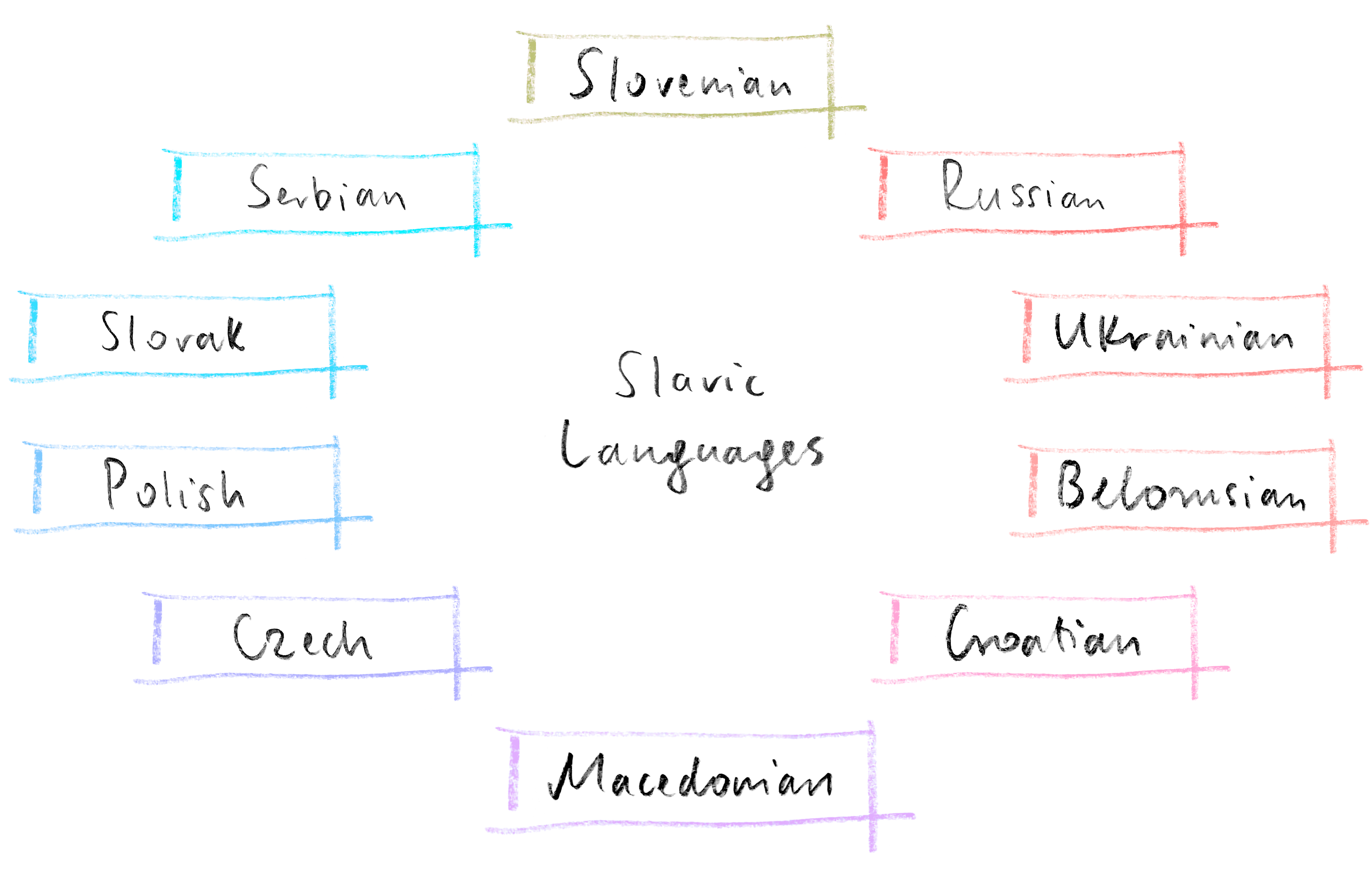
The similarity between these languages is striking: a significant part of the vocabulary is largely the same. At the same time, their grammatical structure shows a lot of common traits as well. Therefore, a person who knows one Slavic language can relatively easily understand the other Slavic languages, too.
HOW RUSSIAN IS WRITTEN
Russian is written using the Cyrillic script which was developed in the 9th century AD, and serves as the official script in various parts of Eurasia. Not all Slavic languages use the Cyrillic script, though: Slovakian, Czech, Croatian and some others are written with a modified version of the latin alphabet.
RUSSIAN SCRIPT VS. CYRILLIC SCRIPT
When we say Russian script, we are talking about the Russian alphabet. Note that this is not exactly the same as the concept of Cyrillic script. Cyrillic is a more general term referring to various alphabets like Russian, Bulgarian, Serbian, etc. There are slight differences between the alphabets of these languages, however, all of them are called Cyrillic.
A FIRST LOOK AT RUSSIAN VOCABULARY
Here are a couple of words to give you an idea of the vocabulary of the Russian language. As you may notice, some of the words are spelt and pronounced almost like in English. You can click on the speaker icon to hear how a native speaker pronounces the word in question.
SALAD
САЛАТ
Play
CHOCOLATE
ШОКОЛАД
Play
RESTAURANT
РЕСТОРАН
Play
AIRPORT
АЭРОПОРТ
Play
BANK
БАНК
Play
TEA
ЧАЙ
Play
LAMP
ЛАМПА
Play
ACTOR
АКТЁР
Play
MILK
МОЛОКО
Play
REAL
НАСТОЯЩИЙ
Play
* Audio samples are provided by The Shtooka Project.
THE RELATIONSHIP BETWEEN CYRILLIC, LATIN AND GREEK SCRIPTS
A careful observer may notice that some of the Cyrillic letters are written the same way as their Latin counterparts, for example, the letters A, O, T. What’s more, some Cyrillic letters may also be found in the Greek alphabet. The reason for this is the fact that these three scripts are related to each other, namely, both the Cyrillic and Latin alphabets were derived from Greek. Sometimes, Greek is referred to as the parent script, whereas Cyrillic and Latin are called the ‘children’. The following Venn diagram shows the exact relationship between these writing systems:
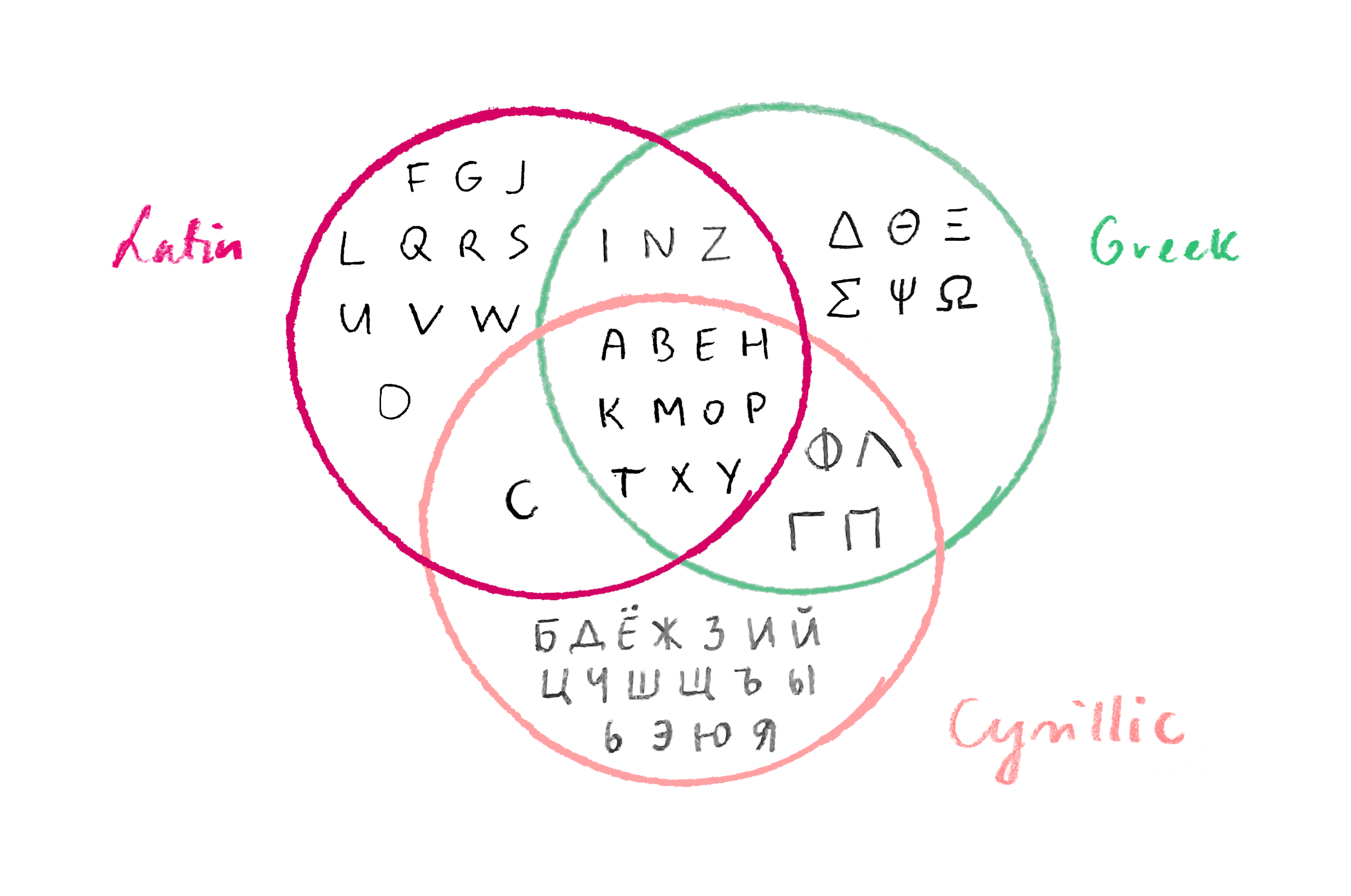
The Latin and the Cyrillic scripts were adapted to a multitude of languages, therefore, there exist a great number of extra letters which were not present in the original systems. In the case of Latin, various diacritical marks were generally added to individual characters, e.g. È (French), Ó (Hungarian). In the case of Cyrillic, new character shapes were usually included in the alphabet when the original letters were not sufficient, e.g. Џ (Macedonian), Њ (Serbian), Ө (Mongolian).
INTERACTIVE QUIZ 1